Facebook
 Linked In
 Twitter
 YouTube

IndiAgri Bureau
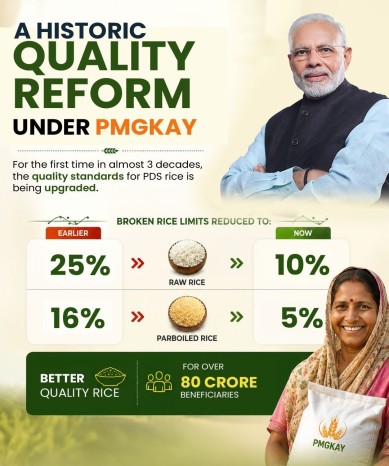
New Delhi: In a major reform aimed at improving the quality of food grains distributed through the Public Distribution System (PDS), the Union Cabinet has approved stricter quality standards for rice supplied under the Pradhan Mantri Garib Kalyan Anna Yojana (PMGKAY) and other welfare schemes. The decision is expected to benefit more than 80 crore beneficiaries across the country.
For the first time in nearly three decades, the government has revised the permissible limit of broken rice in ration supplies. Under the new norms, the broken grain content in raw rice has been reduced from 25% to 10%, while parboiled rice will now be allowed only 5% broken grains, down from the existing 16%.
The procurement of rice under the revised specifications will begin immediately and will be introduced across all procuring states in phases, with full implementation targeted by the Kharif Marketing Season (KMS) 2027-28. Distribution to beneficiaries will also follow a phased rollout.
The government clarified that beneficiaries will continue to receive the same quantity of rice under PMGKAY, but with significantly improved grain quality. The move is expected to enhance consumer satisfaction by providing rice with better grain integrity and appearance.
Rice separated during milling due to the tighter quality standards will no longer be mixed with ration rice. Instead, it will be diverted for industrial and other productive uses, ensuring that higher-quality edible rice reaches beneficiaries.
According to the government, the reform is also expected to improve operational efficiency. Since broken rice will be auctioned directly from rice mills and stored separately in HDPE bags instead of jute bags, transportation, storage and packaging costs are expected to decline.
The Centre estimates annual savings of around ₹2,161 crore, while revenue generated from the sale of broken rice is expected to further reduce the food subsidy burden.
To strengthen transparency in the Public Distribution System, rice bags supplied under the scheme will carry QR codes for end-to-end traceability. The system is expected to improve inventory management and help curb leakages across the supply chain.
The revised quality standards have already been tested through pilot projects in Haryana, Andhra Pradesh, Punjab, Odisha, Telangana and Chhattisgarh, where authorities demonstrated the feasibility of producing improved-quality rice at scale. Rice produced during these pilots will also be supplied under PMGKAY and other welfare schemes.
The Cabinet's decision marks a significant step toward improving not just food security, but also the quality of food provided to millions of households while enhancing efficiency and transparency in India's food grain distribution system.