Facebook
 Linked In
 Twitter
 YouTube

IndiAgri News Desk
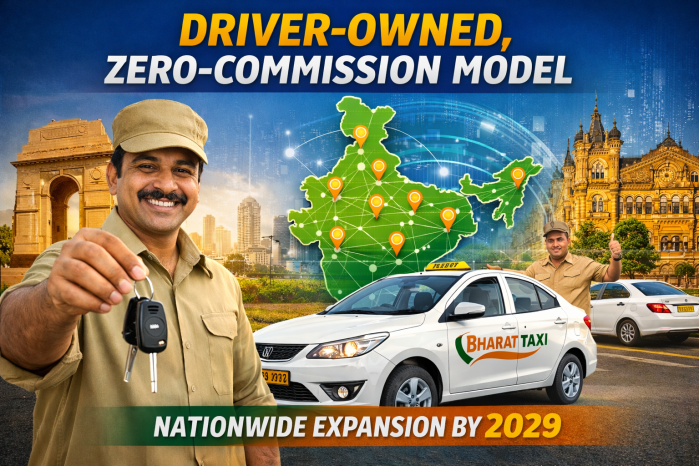
India’s mobility ecosystem may be on the cusp of a structural shift. Bharat Taxi has announced an ambitious national rollout plan through 2029, positioning itself as a zero-commission, driver-owned alternative to app-based aggregators.
At a time when gig workers across sectors are seeking greater earnings stability and ownership, Bharat Taxi’s model aims to reset the equation between platform and partner.
Unlike conventional aggregators that charge commissions on every ride, Bharat Taxi operates on a zero-commission structure. Drivers retain their full fare earnings, while the platform is sustained through a transparent subscription-based model.
The core philosophy is simple: empower drivers as stakeholders rather than service providers at the mercy of fluctuating algorithms. By removing per-ride commissions, the company intends to offer higher income predictability and stronger financial resilience for its partners.
Bharat Taxi’s framework aligns closely with India’s broader push toward inclusive growth and cooperative entrepreneurship. The driver-owned model encourages participation, accountability and long-term engagement—key ingredients for sustainable scale.
As the platform expands city by city, it plans to build strong local driver communities supported by technology, training and compliance systems. This decentralized yet tech-enabled structure is expected to ensure service quality while preserving ownership at the grassroots level.
With a clear expansion roadmap, Bharat Taxi is targeting a pan-India presence by 2029. The phased rollout strategy will focus on strengthening operational depth in key urban centers before expanding into Tier II and Tier III cities.
This approach aligns with the increasing mobility demand beyond metros, where digital adoption is accelerating and consumers are seeking affordable, transparent alternatives.
The zero-commission model challenges the prevailing economics of ride aggregation. By shifting revenue logic away from per-ride deductions, the company is betting on scale, subscriptions and operational efficiency.
For customers, this could translate into competitive pricing and improved service consistency. For drivers, the promise is greater autonomy, better earnings retention and participation in long-term value creation.
The emergence of driver-owned platforms reflects a larger narrative unfolding in India’s gig economy—one that emphasizes dignity of work, income security and shared growth.
If executed effectively, Bharat Taxi’s national rollout could offer a replicable template for platform-based sectors seeking to balance technology innovation with equitable value distribution.
As India advances toward a more digitally integrated mobility landscape, models that combine entrepreneurship with social equity may well define the next phase of growth.