Facebook
 Linked In
 Twitter
 YouTube

IndiAgri Bureau
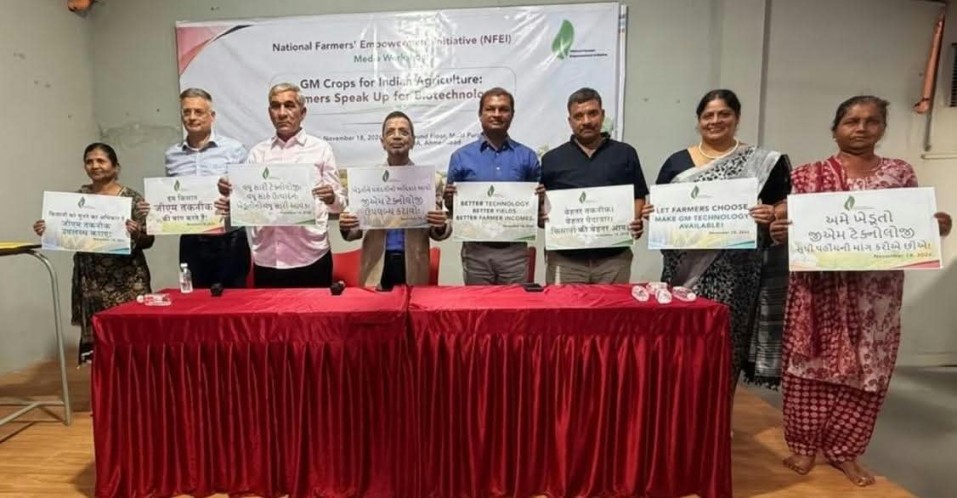
Ahmedabad: Farmers in Gujarat have called for access to next-generation genetically modified (GM) crops and a science-led approach to agricultural technology, arguing that existing crop traits are no longer sufficient to address emerging pest pressures, unpredictable weather and rising cultivation costs.
The demand was raised at a media workshop organised by the National Farmers Empowerment Initiative (NFEI) in Ahmedabad on Wednesday. Participants said India needs to move beyond the technology currently available to cotton growers and consider improved crop traits through a predictable and science-based regulatory framework.
Gujarat was among the early adopters of Bt cotton following its approval in India in 2002. According to Ministry of Agriculture data cited at the workshop, India's cotton yield increased from 186 kg per hectare in 2001-02 to 510 kg per hectare in 2013-14. The country also moved from being a net importer of raw cotton before 2002 to becoming a major exporter.
However, Bt cotton remains the only GM crop commercially approved for cultivation in India. Bollgard II, introduced in 2006, is still the latest cotton technology available to farmers.
The emergence of pink bollworm resistance has added to concerns. The pest first overcame single-gene Bt cotton in Gujarat in 2009 and has since developed resistance to Bollgard II. In contrast, newer cotton technologies available globally combine protection against bollworms and sucking pests with tolerance to multiple herbicides.
“Bt cotton made a difference to cotton cultivation in India. Today, farmers face new pests, unpredictable weather and rising costs. We need access to improved technologies and better crop traits,” said Prakash Punambhai Patel, a farmer from Simri village.
The workshop also highlighted the scale of global GM crop adoption. According to ISAAA's report on biotech crops in 2024, GM crops covered 218.71 million hectares worldwide that year. Since 1996, 73 countries have adopted these crops, including 44 through cultivation and 29 through imports.
The World Health Organization has stated that GM foods available in international markets have undergone safety assessments and are not likely to present risks to human health.
Dr Vijay Kumar, former Research Scientist and Head of Cotton at Navsari Agricultural University, said the discussion should focus on responsible assessment and the role of technology in addressing agricultural needs.
“The key question is not whether technology should be used, but how it can be assessed responsibly and deployed to meet the needs of Indian agriculture,” he said.
Participants identified regulatory uncertainty as a major obstacle to the introduction of new GM technologies in India.
Bt brinjal, which received approval in 2009, has remained under a moratorium since February 2010. GM mustard hybrid DMH-11, recommended for environmental release in October 2022, is also awaiting a final decision following a split Supreme Court verdict in July 2024.
Field trials face additional challenges, as they require a no-objection certificate from the respective state governments. In 2023, Gujarat and Telangana declined permission for trials of genetically engineered cotton hybrids developed to address pink bollworm.
Farmers at the workshop said that policy decisions must keep pace with scientific developments while ensuring adequate information and guidance for cultivators.
“Farmers will adopt technologies that improve productivity and protect crops if they receive the right information and guidance. Agricultural policies must keep pace with science,” said Mukesh Kantilal Patel, a farmer from Chanasma in Patan district.
The discussions also covered the potential of GM technology and genome editing to develop crops with improved productivity, climate resilience and nutritional value.
Participants pointed to the release of two genome-edited rice varieties in India in 2025 as an example of the country's progress in crop improvement. They called for a predictable regulatory system that subjects new technologies to rigorous evaluation and enables their timely availability once safety requirements are met.
Bharat Char, Chief Science Officer at Mahyco and Head of the Alliance for Agri Innovation, emphasised the importance of field-level testing across different agro-climatic conditions.
“Farmers deserve a choice of the best technologies available anywhere in the world. Field trials must continue across agro-climatic zones so that Indian science is ready to deliver proven, safe traits the moment policy allows,” he said.
The workshop concluded with farmers stressing that they should have a meaningful role in decisions concerning agricultural technologies. They said access to improved crop traits, backed by scientific assessment, field trials and clear policy, would be important for addressing the changing challenges facing Indian agriculture.





.jpeg)