Facebook
 Linked In
 Twitter
 YouTube

IndiAgri Bureau
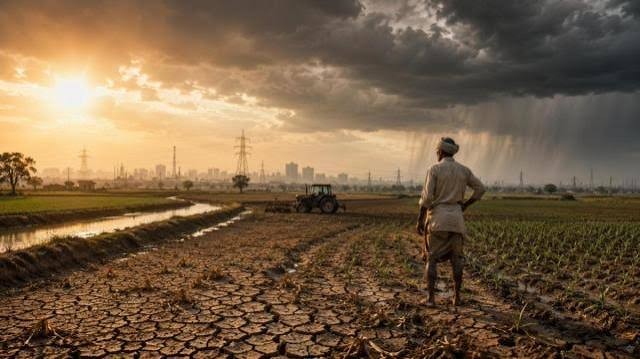
New Delhi: Rising temperatures, erratic rainfall and drought conditions are putting increasing pressure on India's agricultural and food systems, with consequences extending from farm production to food prices and household budgets. A new white paper by Climate Trends warns that the growing climate risks could further threaten farmers' livelihoods, food security and the country's food supply chains.
Titled From Risk to Resilience: Climate Change, Ecology and the Future of Indian Agriculture, the report highlights how extreme weather events are disrupting agricultural production, increasing post-harvest losses and affecting the availability and affordability of food.
The paper warns that heatwaves, unpredictable rainfall and the prospect of what it describes as the worst El Niño since 1950 could intensify the challenges facing Indian agriculture.
India is already experiencing a difficult post-monsoon season, with drought conditions reported in Karnataka, Maharashtra, Andhra Pradesh, Telangana and Rajasthan. The report also refers to six states having declared drought conditions.
Meanwhile, Union Agriculture Minister Shivraj Singh Chouhan was recently quoted as saying that extreme rainfall and floods had affected around 6.11 lakh hectares of cropland. Gujarat has also announced crop-loss compensation, subsidised fodder and employment support for farmers in four drought-affected districts.
The report highlights that climate-related losses are not restricted to agricultural fields. They are affecting the entire food supply chain, including storage, transportation, markets and household consumption.
Palak Balyan, research lead at Climate Trends, said India's food losses should be viewed as a systemic challenge rather than only an agricultural problem.
Nearly one-third of fruits and vegetables are lost before reaching consumers, with heatwaves and erratic rainfall adding to post-harvest losses.
Balyan also pointed to the impact of rising temperatures on dairy production and declining soil health. She emphasised the need for sustained investment in storage infrastructure, agricultural extension services and market access, alongside better weather forecasting, to ensure farmers are not left bearing the burden of climate-related losses.
Dr G V Ramanjaneyulu of the Centre for Sustainable Agriculture warned that the effects of the current drought could continue to affect agricultural livelihoods in the coming years.
Aarti Khosla of Climate Trends said Indian agriculture was facing pressure from both climate-related disruptions and existing structural weaknesses, including deteriorating soil health, declining groundwater levels and decades of input-intensive farming.
She also highlighted the risks associated with dependence on fertilisers manufactured using imported fossil fuels, particularly amid geopolitical uncertainty and disruptions to global supply chains.
The report highlights the economic cost of rising temperatures on India's dairy sector.
According to the researchers, heat stress results in estimated annual losses of ₹2,661 crore in milk production. This is equivalent to approximately 1.8 million tonnes of milk, or around 2% of the country's total milk output.
The livestock sector is also vulnerable to extreme weather. The report estimates that approximately 40% of India's livestock population is exposed to climate-related risks.
These challenges underline the need to strengthen climate resilience across dairy production, livestock management and animal health systems.
Inadequate post-harvest infrastructure is another major concern highlighted in the report.
Weak cold-chain infrastructure is estimated to cost India around $13 billion annually. Researchers estimate that up to 40% of fruits and vegetables and 5–6% of food grains are lost before reaching consumers.
Only around 4% of India's fresh produce is covered by cold-chain facilities, pointing to a significant infrastructure gap.
The report stresses that improving storage, transportation and market access will be important in reducing food losses and protecting farmers' incomes.
The scale of climate-related risks is also reflected in the extent of agricultural land exposed to extreme weather events.
According to the researchers, more than 20 million hectares of agricultural land, representing over 14% of India's total sown area, have been affected by floods, droughts, cyclones, heatwaves, cold waves and other natural hazards.
Around 45% of India's crop-producing land is located in areas exposed to significant flood risk.
The report also points to the growing pressure on soil resources from intensive agricultural practices. Per-hectare chemical fertiliser consumption more than doubled over three decades, rising from 73.5 kg in 1990 to 199 kg in 2023.
Calling for a transition towards a more sustainable food system, the white paper emphasises the need to strengthen agricultural resilience through improved natural resource management and agroecological approaches.
With climate-related disruptions increasingly affecting production, livestock, storage and food markets, the challenge for India will be to build resilience across the entire agricultural value chain rather than addressing individual weather-related crises in isolation.



.jpg)