Facebook
 Linked In
 Twitter
 YouTube

Priya Singh
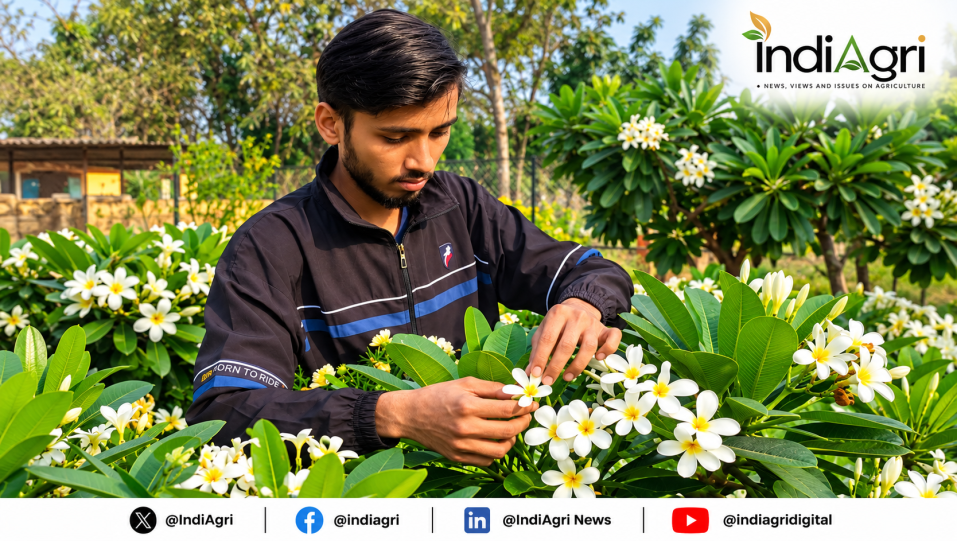
Ayodhya: Plumeria, widely known as frangipani, temple tree, pagoda tree and gulachin, is familiar across tropical landscapes for its colourful flowers and distinctive fragrance. But beyond its ornamental appeal, the crop has applications in landscaping, nursery production, floral decoration, perfumery, cosmetics and cultural practices.
A review article shared with IndiAgri by researchers from the College of Horticulture and Forestry, Acharya Narendra Deva University of Agriculture & Technology (ANDUAT), Kumarganj, Ayodhya, examines the botanical characteristics, diversity, propagation, cultivation, traditional uses and floriculture potential of Plumeria.
The review, titled “The Scent of Tropics: Nature’s Fragrant Jewel Plumeria”, has been authored by Sunil Kumar, Assistant Professor, Department of Floriculture and Landscaping; Arpita Mishra, PG scholar, Department of Floriculture and Landscaping; Arpit Kumar Maurya, PG scholar, Department of Floriculture and Landscaping; S. K. Verma, Associate Professor, Department of Fruit Science; Atul Kumar Prajapati, PG scholar, Department of Floriculture and Landscaping; and Rohit Mishra, Ph.D. Scholar, Department of Floriculture and Landscaping. All the authors are associated with the College of Horticulture and Forestry, ANDUAT, Kumarganj, Ayodhya, Uttar Pradesh.
The researchers describe Plumeria as an economically important ornamental plant of tropical and subtropical regions. The genus is valued for diversity in flower colour, morphology, growth habit and flowering characteristics, making it relevant to ornamental horticulture and urban landscaping. The review also examines its ecological, cultural and traditional importance.
Plumeria belongs to the Apocynaceae family. The researchers note that it is native to Central America, Mexico, the Caribbean and northern South America and has been introduced into several parts of Asia, Africa, Australia and the Pacific Islands because of its ornamental value and adaptability.
The paper refers to approximately 11 accepted species based on its cited 2025 source. However, current Kew Plants of the World Online records 18 accepted species under the genus Plumeria, including Plumeria alba, P. obtusa, P. rubra, P. pudica and others. For publication, the current figure of 18 is more appropriate.
Plumeria is particularly recognised for its flowers, which occur in white, cream, yellow, pink, red, orange and multicoloured forms. The researchers note that the fragrance is particularly pronounced during the evening and can attract pollinators. The plant is consequently used extensively in home gardens, public parks, avenue plantations, temples and urban landscapes.
The plant also carries considerable cultural importance. In India and several Southeast Asian countries, Plumeria is associated with religious and ceremonial practices, while in Hawaii it is closely linked with leis and cultural celebrations. The flowers are used in garlands, temple offerings and decorative purposes.
The review records a wide range of traditional uses and phytochemical findings associated with Plumeria. Researchers cited in the paper have reported compounds belonging to groups such as iridoids, terpenoids, phenolic acids, flavonoids, cardiac glycosides, steroids, fatty acid esters and coumarins, particularly in Plumeria obtusa.
The authors also discuss traditional medicinal applications reported for different parts of the plant. These include historical and traditional uses of P. alba and other Plumeria species for various ailments. However, these references concern traditional use and phytochemical research and should not be interpreted as proof of clinical efficacy.
From a botanical perspective, Plumeria is a perennial, deciduous to semi-evergreen shrub or small tree. The review states that plants can reach around 3–10 metres under suitable conditions. They develop thick, fleshy grey-green branches that exude milky latex when injured. Leaves are generally concentrated towards the ends of branches and can measure around 20–50 cm in length.
The flowers are borne in terminal clusters and generally have five overlapping petals. According to the review, individual flowers can measure around 5–10 cm across. The plant produces paired, elongated follicles containing winged seeds, although fruit formation can be uncommon in cultivated ornamental hybrids because of reduced fertility. Flowering generally extends from spring to autumn and may continue for much of the year under favourable tropical conditions.
The researchers highlight several Plumeria species and cultivars commonly valued in ornamental horticulture. These include Plumeria rubra, known for its vibrant red, pink and yellow flowers; P. obtusa, recognised for glossy foliage and fragrant white flowers with yellow centres; and P. alba, known for fragrant white flowers. The review also mentions hybrids such as ‘Hawaiian Rainbow’ and ‘Sunset’, selected for their distinctive flower colours.
For the floriculture sector, the crop offers multiple avenues of use. The review identifies landscape design as one of the major applications, with Plumeria serving as a focal plant in tropical and subtropical gardens. Its colourful and fragrant flowers can add visual and sensory value to public and private landscapes.
Plumeria can also be grown in containers, making it suitable for patios, balconies and smaller urban spaces. With suitable pruning, the plants can be incorporated into screening and hedging arrangements. Their flowers are also used in floral arrangements and decorative displays.
The researchers further point to its ecological value. The fragrant flowers can attract pollinators including bees and butterflies, while the plant's ability to tolerate relatively dry conditions once established makes it potentially useful in water-conscious landscaping.
For growers, the review recommends selecting sites receiving at least six hours of full sunlight each day and using well-drained sandy or loamy soil. Good drainage is important because excessive moisture can increase the risk of root rot. The researchers also note that regular pruning can help maintain plant shape and encourage bushier growth, while fertilisation during the growing season can support flowering.
The paper recommends spacing plants around 6–10 feet apart to allow adequate air circulation. Propagation can be undertaken through stem cuttings, seeds and air layering. For cuttings, the researchers recommend healthy mature stems of around 6–12 inches, with the cuttings allowed to callus for two to three days before planting in a well-drained medium.
Like other ornamental crops, Plumeria is not free from pest and disease problems. The review identifies aphids, mealybugs and spider mites among the pests that may affect plants. Fungal diseases can also become a concern under excessively humid conditions, making regular monitoring and appropriate crop management important.
The researchers see further scope for Plumeria through germplasm characterisation, development of improved cultivars, breeding for desirable ornamental traits and greater stress tolerance. Their review also points to the potential role of modern biotechnological approaches in expanding the crop's commercial utilisation.
For India's expanding floriculture and landscaping sector, this makes Plumeria an interesting crop to watch. Its combination of flower diversity, fragrance, cultural relevance, landscape value and relatively manageable cultivation requirements provides opportunities for nurseries, landscape developers and ornamental plant growers.
The researchers conclude that Plumeria's importance extends beyond its visual appeal. Its role in ornamental horticulture, cultural practices and ecological landscaping gives it wider relevance, while further research into genetic resources, improved cultivars and production technologies could help unlock additional commercial opportunities.