Facebook
 Linked In
 Twitter
 YouTube

IndiAgri Bureau
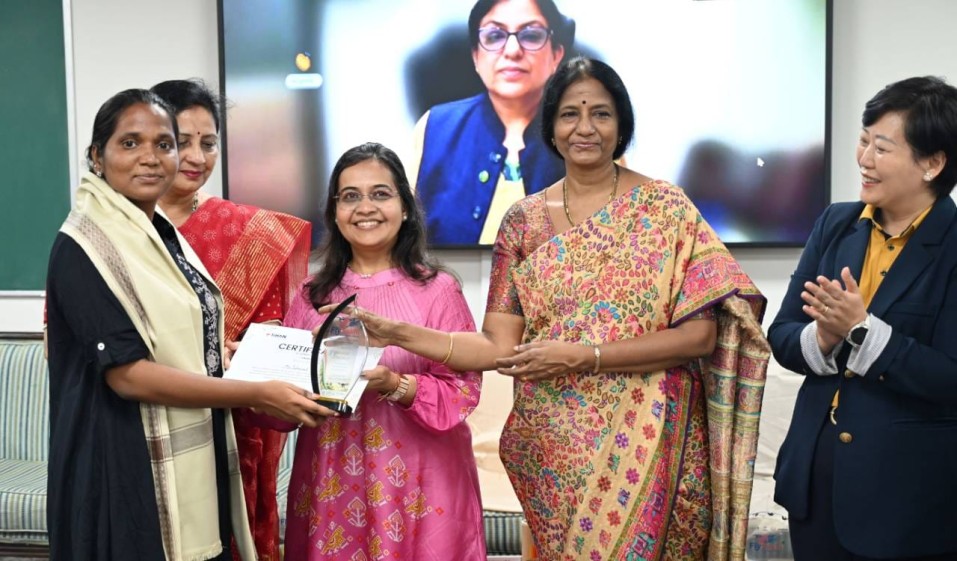
Hyderabad: Twenty-five rural women have completed the first cohort of FlySakhi – Drone Queens of Bharat, a programme aimed at building women-led agricultural drone-service businesses and expanding access to technology-driven farming services.
The women received their certificates at a valedictory session held at TiHAN, IIT Hyderabad, on October 15. The programme combines drone-operation training with business skills to help participants explore opportunities to provide services to farmers, cooperatives and Farmer Producer Organisations (FPOs).
FlySakhi is led by the World Cooperation Economic Forum (WCOOPEF) and the Confederation of NGOs of Rural India (CNRI), with TiHAN–IIT Hyderabad as its technology partner and Syngenta India as its corporate social responsibility (CSR) partner. It is a flagship activity under the Civil Society Resilience and National Awareness Mission (CSRNAM) 2026 and is aligned with the United Nations’ International Year of the Woman Farmer 2026.
_1792216841.jpeg)
The first cohort began training on October 5 with virtual theoretical modules, followed by practical drone-flight sessions at TiHAN, IIT Hyderabad. The training covered drone operation, flight safety, agricultural applications and the Drone-as-a-Service business model.
The programme aims to help graduates move beyond operating drones to establishing their own service enterprises. According to the organisers, certification is intended to support credit linkages, enabling participants to explore financing options for acquiring equipment and starting businesses.
Sangeeta Dawar, Head of Business Sustainability and Corporate Affairs at Syngenta India, said the company’s support for FlySakhi reflects its focus on rural skills, livelihoods and responsible agricultural practices. The company also runs initiatives such as I RISE, which focuses on skill development for rural youth, I CLEAN, which promotes cleanliness and community awareness, and WeCare, its stewardship initiative.
Dr. C. Tara Satyavathi, Director General of ICAR–National Institute of Plant Health Management (NIPHM), said agricultural drones could improve the efficiency and precision of farming services, but their adoption requires appropriate training and practical knowledge. She noted that programmes such as FlySakhi could create opportunities for rural women to participate in the growing agricultural services sector.
Agricultural drones are increasingly being explored for applications such as crop spraying, crop monitoring and field assessment. For rural women, providing these services could create an additional source of income while helping farmers access technology without necessarily investing in equipment themselves.
The FlySakhi model also seeks to connect trained women with Self-Help Groups (SHGs), cooperatives and FPOs. Such partnerships could help participants reach more farmers and develop local demand for drone-based services. However, the long-term viability of these enterprises will depend on access to finance, equipment, maintenance, regulatory compliance and a steady customer base.
The initiative complements wider efforts to expand agricultural drone use, including the Namo Drone Didi programme, while placing particular emphasis on entrepreneurship and community-level service delivery.
The valedictory session was attended by representatives from academia, agricultural research, industry and civil society. Dileep Shanghani, Chairman of WCOOPEF, delivered the inaugural address, while Dr. C. Tara Satyavathi attended as the chief guest. Meenal Maheshwari, Chief Financial Officer of Syngenta India, delivered the presidential address. Representatives from TiHAN–IIT Hyderabad, CNRI, NABARD and other participating institutions were also present.
The programme partners plan to organise additional training cohorts and work towards connecting graduates with credit facilities, cooperatives, FPOs and potential customers. Their longer-term aim is to build a network of women-led drone-service enterprises across rural India.
The first cohort marks an initial step towards that goal. Sustained access to financing, training and viable business opportunities will be important in determining whether the initiative can translate technical skills into lasting livelihoods for rural women.