Facebook
 Linked In
 Twitter
 YouTube

Priya Singh
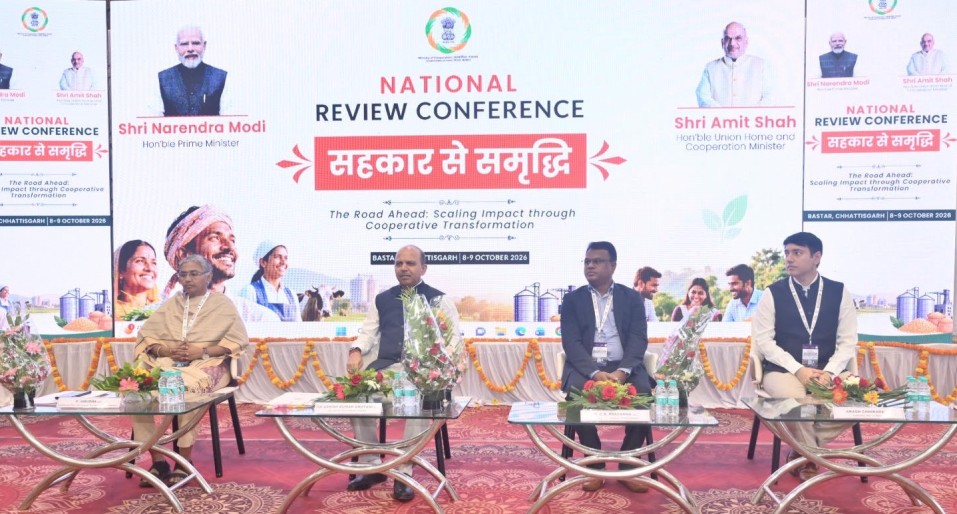
Bastar: India's cooperative sector needs state-specific action plans, stronger grassroots institutions and better market linkages to translate policy reforms into tangible benefits for farmers. This was the key message from the ninth National Review Workshop organised by the Ministry of Cooperation in Bastar, Chhattisgarh, on October 8–9.
The two-day workshop brought together state officials, registrars of cooperative societies, national cooperative institutions and sector stakeholders to review progress in cooperative banking, Primary Agricultural Credit Societies (PACS), dairy cooperatives, digitalisation, agricultural marketing and decentralised grain storage.
Dr. Ashish Kumar Bhutani, Secretary, Ministry of Cooperation, called on states to prepare prioritised action plans with clear responsibilities, defined timelines and regular monitoring. He stressed that India's diverse regional conditions require locally adapted approaches rather than a uniform cooperative development model.
The discussions also highlighted the need to identify successful state-level initiatives, document their outcomes and replicate them where suitable.
National Cooperative Exports Limited (NCEL), National Cooperative Organics Limited (NCOL) and Bharatiya Beej Sahakari Samiti Limited (BBSSL) featured in discussions on strengthening grassroots cooperatives.
These institutions can help cooperatives aggregate agricultural produce, connect with wider markets and improve price realisation for farmers and members. The Ministry also encouraged states to explore fertiliser-related business opportunities for PACS, where feasible, to diversify their revenue sources and strengthen financial sustainability.
The workshop emphasised that cooperatives need to become more than local channels for credit and agricultural inputs. Stronger links with markets and diversified services could help them become more viable institutions for rural communities.
Expanding the network of PACS was another key focus. The Ministry urged states to accelerate the formation of new societies, reorganise existing ones where appropriate and increase membership.
The workshop referred to a target of establishing approximately 95,000 new PACS over the next two to three years. A stronger primary cooperative network is also considered important for supporting the viability of District Central Cooperative Banks.
On digitalisation, states were asked to complete the first phase of PACS computerisation by December 2026. Audits for the financial years 2024–25 and 2025–26 are to be completed by October 2026.
The Ministry also stressed timely reconciliation of accounts and regular updating of records to prevent implementation delays.
Cooperative banks need to strengthen cybersecurity and upgrade their technology infrastructure as digital transactions expand, Dr. Bhutani said during the workshop.
Cyber fraud and fragmented banking systems remain challenges for parts of the sector. A standardised Core Banking Solution platform being developed with NABARD's involvement is expected to help participating banks improve service delivery.
The discussions also highlighted the need to expand internet and mobile banking, helping cooperative banks retain existing customers and attract younger users.
The workshop reviewed progress under the World's Largest Grain Storage Plan in the cooperative sector, with states encouraged to speed up the identification of sites, loan approvals and construction of godowns.
Beyond storage, the infrastructure could help farmers explore additional marketing and financing options. The Ministry is examining models such as pledge finance, under which farmers could use stored produce to access credit rather than sell immediately when prices are unfavourable.
Dr. Bhutani clarified that such models would supplement, not replace, the Minimum Support Price (MSP) framework. The focus would include commodities, particularly cereals other than wheat and paddy, for which access to MSP-based procurement can be limited.
The Ministry plans to share potential models with states over the next two to three months and explore pilot projects in selected districts before considering wider implementation.
Discussions also covered the formalisation of village-level milk collection arrangements into organised cooperatives. Bringing more milk producers into cooperative institutions could help them access structured services and benefit from collective participation.
The workshop reviewed experiences from states and Union Territories including Uttar Pradesh, Madhya Pradesh, Andhra Pradesh, Jammu and Kashmir, Gujarat, Bihar and Puducherry. These examples were presented as potential models for adaptation, depending on local requirements.
The broader objective is to strengthen cooperatives as institutions that connect rural producers with credit, markets, storage, technology and agricultural services.
The next National Review Workshop is proposed to be held in Mahabalipuram, Tamil Nadu, in January 2027.